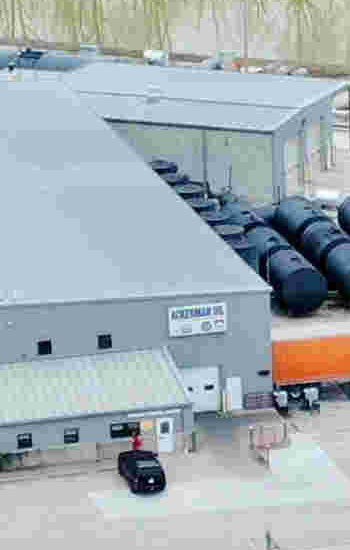
Directions to Ackerman Oil's Warehouse Facility:
From the South:
From I-64, take exit # 57 onto US 231 North. Go approximately 12 miles North on US 231 to Jasper, IN. The first stop light on the South edge of Jasper is the Junction of SR 162. Turn Right (East) on SR 162. Make an immediate right onto Lube Way, and continue South between the gas station and Rural King to the grey warehouse at the bottom of the hill on the left.
From the North:
You will come into Jasper on US 231. Stay on US 231 to the South edge of Jasper. The last stop light is the Junction of SR 162. You will see a gas station on the left at this intersection. Turn Left (East) on SR 162. Make an immediate right onto Lube Way, and continue South between the gas station and Rural King to the grey warehouse at the bottom of the hill on the left.
Click here for directions using Google Maps
Services
Transportation:
Ackerman Oil's Transportation affiliate provides For Hire hauling of bulk liquid commodities for a number of satisfied customers. We are not the cheapest carrier on the block, but we do have one of the best on time in full records in the industry. If quality matters, we can fill your needs.
Supplemental Filtration:
Ackerman Oil has invested in a Vacuum Dehydration Filter Cart to serve the needs of customers who desire to obtain extended life from their lubricants, or who need help to clean up oils that have become contaminated with water. With run rates of up to 250 gallon per hour, we can make short work of larger batches.
Terminaling:
Our rail spur is serviced by short line Dubois County Railroad off of the Norfolk Southern System. We are able to provide steam heat to several positions on the spur to get viscous materials warmed for truck shipping. We load Tank Trucks, ISO Containers, and can repackage materials into drums and totes. If you need a responsive partner in distribution we are your company.
Quality Fuels
As an ISO 9000 Quality Certified Organization, Ackerman Oil sources high quality fuels from reliable sources. Our fuels include additive packages to meet or exceed the requirements of today's modern engines to provide our customers with trouble free operations. We proactively manage our fuel storage and distribution systems to ensure that the products that we deliver meet our standards of excellence. Our bulk trucks used for commercial delivery of fuel to farms and commercial accounts are equipped with on board 2 micron filtration to provide an additional level of quality assurance of clean fuels.
- We inventory a variety of fuels including:
- multiple octane grade of ethanol free gasoline
- multiple octanes of E-10 ethanol blends
- 15ppm Ultra Low Sulfur Diesel (on road)
- 15ppm Ultra Low Sulfur Dyed Diesel (off road)
- B-5 BioDiesel Ultra Low Sulfur Dyed Diesel (off road)
- Dyed #1 Heating Oil and K-1 Kerosene
- Products such as E-85 and E-15 (Unleaded 88) are available for direct delivery from terminal
Lubricants & Transformer Oils
Ackerman Oil is pleased to sell and distribute lubricants from leading manufacturers including Petro-Canada, an HF Sinclair company with USA headquarters. Our modern warehouses and tank farms allow us to supply you with the products you need in a timely manner. To help you solve your lubrication issues, our internal expertise is supplemented with technical support from our alignment with excellent manufacturers. From Bulk Delivery to drums and other small containers, we can supply your needs for the right lubricant.
Click to learn more about Petro-Canda, an HF Sinclair company with USA headquarters
Safety Data Sheets
Click for safety data sheets from Petro-Canada
If you are unable to find the product that you are seeking using the links provided, please contact Ackerman Oil office at 812-482-6666 or 24 hour emergency phone 812-630-8756. Ackerman Oil is a subscriber member of Chemtrec.
Fuel Tax Rates
| Effective Date | Code | Description | Federal Spill / Superfund |
Federal LUST |
Oil Inspection Fee |
Federal Excise |
Indiana Excise |
IN Gasoline Use Tax |
IN State Sales Tax |
|---|
| Effective Date | Code | Description | Federal Spill / Superfund |
Federal LUST |
Oil Inspection Fee |
Federal Excise |
Indiana Excise |
IN Gasoline Use Tax |
IN State Sales Tax |
|---|
CONTACT US
Send us a letter
ACKERMAN OIL CO INC
PO BOX 806
JASPER, IN 47547-0806
(812) 482-6666